Abraham Education · Mini PD for AIM Academy · 25 minutes

Contingency Contracting
for Whole Classes

A 1970 classroom method that turned three unmanageable three-year-olds into a working class in one month. Here is how it works, what it says about whole classes, and how to run it in yours.

Short readsListen optionQuick exercisesBuild your own contract

Start the course

Your name and email let Michael see who finished and follow up. Your answers are saved to the PD sheet.
ABRAHAM EDUCATIONMini PD
1
About 2 minutes

Three kids who would not sit down
In 1963, psychologist Lloyd Homme had a problem. He had three three-year-olds, and he was not allowed to use punishment or candy. On the first day his control over them was, in his own summary, none. One child ran and screamed, one shoved a noisy chair across the floor, and one worked a jigsaw puzzle.
Then he tried an idea from psychologist David Premack. Whatever a person is likely to do on their own can be used to strengthen something they are less likely to do. So Homme stopped fighting what the children wanted. He watched them. They loved to run, scream, push chairs, and do puzzles.
FIRST Sit quietly and look at the board then THEN "Everybody, run and scream, now." The reward was whatever the kids were already choosing to do.
Sitting quietly came first, for a very small amount of time. Running and screaming came right after, on command. According to Homme, that put him in control, and within about a month he had taught what was normally taught in first grade.
Where this comes from
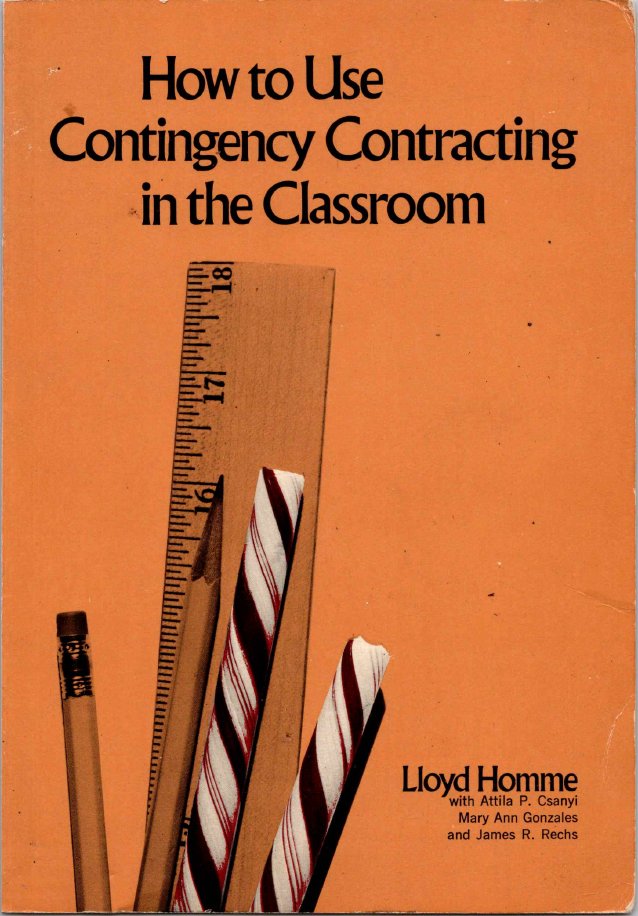
Cover of How to Use Contingency Contracting in the Classroom by Lloyd Homme

How to Use Contingency Contracting in the Classroom, by Lloyd Homme with Attila Csanyi, Mary Ann Gonzales and James Rechs. Research Press, revised edition, 1970. It grew out of US Office of Education research grants and was field tested with teachers. Wesley Becker of the University of Illinois wrote the introduction, arguing that school failure has causes in how we teach and motivate, not in labels like low intelligence.

The book is written as programmed instruction: short chunks, quick checks, skip what you already know. That is the format of this course too.

TRY IT

Make a prediction

Before you read on: what do you think Homme used as the reward for sitting quietly?

2
About 3 minutes

If first you do X, then you may do Y

A contingency contract is an agreement where an outcome depends on performance. The book boils every contract down to one sentence: if first you do X, then you may do or get Y.
There are two kinds. A negative contract says do this to avoid punishment. A positive contract says do this and you get something you want. The book's point is that schools have traditionally leaned negative, while most of daily life runs on positive contracts. You put in a coin, you get the drink. You work a month, you get paid. Even traffic law is negative: obey and you are simply not punished.
TASK CARDsmall, clear amount+ a stop signal PROGRESS CHECK2 to 5 quick itemspass = move on RE MENUstudent picks onething they like RE TIME3 to 10 minutesthen a signal signal rings, back to the next task card
The whole system on one line. RE means reinforcing event: anything students like that you can schedule after the work.
The interesting part

You do not guess the reward. You watch what students choose when they have a free moment, and the student is the best source of information about what works right now. A reward can even be an academic activity. If a student prefers reading to arithmetic, the contract is ten problems first, then ten minutes with the novel. If the student prefers arithmetic, flip it.

TRY IT

Positive or negative?

Tap the type of contract for each statement.

TRY IT

Spot the rewards already in your room

Think of one class you teach. When students get a few free minutes, what do they choose to do? List three specific things.

3
About 3 minutes

What makes a reward actually work

A reward has to pass two tests. First, it must be highly desirable to that student. Second, it must not be available any other way. If students get it anyway, nothing is contingent, and it stops working. Even a good reward fades if it becomes less wanted or becomes easy to get somewhere else.
Desirable?Do they really want itright now? + Only here?Can they get it onlyby doing the work? = A realreinforcer
The book defines a reinforcer by what it does, not what it is. If the behavior does not increase afterward, it was not a reinforcer for that student, no matter how much you think they should like it.
Chapter eight adds practical rules for choosing rewards for a classroom. Pick things students can do quietly, ideally alone or in small numbers. The best ones tie to your learning objectives, like a short discussion with the teacher, a role play, or a related film clip. Time matters too: between three and ten minutes per reward. Under three, they cannot get into it. Over ten, it loses its value as a reward for finishing work.
Small detail worth stealing

The book also lists momentary rewards: getting a drink, going to a locker, erasing the board. These are things students already ask for all day. The move is to make them contingent. First finish the task, then go.

And watch for satiation. A student who picks the same reward every day will wear it out, so rotate the menu and take suggestions from students.

TRY IT

Build a class menu

Tap ideas to add them, or type your own. Aim for at least five, mostly quiet, with some tied to your lesson goals.

0items
0quiet
0tied to learning
Add your first idea to get started.
4
About 2 minutes

Grandma's Law and the ten rules

The book says you already know most of this. Grandma's Law: first clean up your plate, then you may have your dessert. The difference is how seriously and how often. Ordinary first work, then play happens once or twice a day. In contingency contracting the work is cut into small pieces, so the sequence happens dozens of times a day.
The authors name ten rules. Five are about how to use rewards. Five are about the contract itself. Tap each card to see it in plain terms.
Rules about rewardsRules about the contract
Two surprises

First, the book's answer to "isn't it wrong to reward kids for what they should be doing anyway?" Children learn better and more willingly when something good follows a hard task. School already hands out fun things. The only real difference is when.

Second, the rules work all the time, whether you notice them or not. Whatever follows a behavior strengthens it. The book's advice for unwanted behavior is to make sure it never pays off, and to reward something that cannot happen at the same time.

TRY IT

Which rule is broken?

Pick the rule each contract breaks. You will see a stronger version after you get it.

5
About 6 minutes

The whole class problem

Here is the part that matters for most of us. The book expects the question: this works for one student, but how do I do it with thirty at once? The authors answer that doing it for the whole class at once is not only almost impossible, it is unnecessary. They give three reasons.
One: students need different amounts of work. Two: students do not all like the same rewards. Three, the big one: students finish at different times. If the reward waits for everyone, what you are really rewarding is sitting quietly and waiting.
See the trap
The book's answer is individual contracts, made easy with task cards, quick progress checks and a shared menu. The class does not have to do the same thing at the same time. It has to share the same system. In this course, we call that one system, many paces.
Our adaptation for AIM

Same objective, tiered task cards. Everyone aims at the same standard, but cards come in two or three levels, each with a small amount of work.

A progress check you can grade in seconds. The book says two to five objective items per task, ideally self-checked or swapped with a partner.

Rewards start when you pass. No waiting for the slowest student. Early finishers go to the menu, and a clock signal brings everyone back together.

Two or more cycles per period. The book says the average student should complete at least two task units and the same number of reward periods in a fifty minute class.

Launch it backwards. The book teaches the system in reverse, like teaching the word Washington by saying ton first. On day one, let students experience the reward and the menu first, then show how a passed check opens the menu, then add the task.

Skip what they know. The book lets students who score ninety percent or better on a pre-check skip that material.

TRY IT

Plan one period

Slide to set your class length, how many task and reward cycles you want, and reward time. The bar redraws and flags anything the book would question. We assume three minutes to launch and one minute per progress check.

50
2
5
LaunchTaskCheckReward
    TRY IT

    Which design would you run?

    28 students, 45 minute block, one standard. Pick the best design.

    FOLLOW UP

    Same class, 90 minute block

    Now the same 28 students are in a 90 minute block at AIM, still one standard. Pick the best design.

    6
    About 2 minutes

    Handing over the controls

    The goal is not a class that works for rewards forever. The book's real goal is self-management. So the system shifts control in five levels, from the teacher setting everything to the student setting everything. The two things that move are how much task and how much reward. At each stage, students practice every form before moving up.
    Fun detail from the book

    In a Job Corps program the book describes, students picked their own task cards. Then they rolled two dice to decide how long their reward lasted. Try it with one die plus two, which gives three to eight minutes, the same range the book suggests for varied reward times.

    ?
    Our adaptation for AIM

    In a whole class, level one is where you start. Level two can begin in week two. Let the class vote on menu items, or let each student choose between a four problem card and a six problem card. Keep a visible record of completed contracts for each student. The book notes that seeing your own progress is itself rewarding.

    TRY IT

    Your first student voice move

    7
    About 3 minutes

    When a contract stops working

    The book's stance is blunt. A student fails because the motivation system fails, not because the student is stupid or bad. So when something looks off, change the contract, not the child. Seven warning signs show up in the book: unfinished assignments, complaining, dawdling, talking and wasting time, watching the clock, ignoring directions, and failing more than two progress checks in one subject.
    There are only two fixes. Lengthen the contract if a student finishes early, or shorten and simplify it if a student keeps falling short. If shortening does not help, the rewards probably do not appeal to that student, so find ones that do.
    Details that matter

    When a student finishes early, let them enjoy the extra time that day. Lengthen tomorrow's contract and frame it as a step up in status. When a student tries hard and still misses after two or three attempts, give an easier task they can pass, then the reward. Entry to the reward area must always follow a real performance.

    TRY IT

    Diagnose three classrooms

    Some teachers resist this method. The book is honest about why: it can feel like bribery, or like something kids should not need. Tap the concerns you share to see how the authors respond.
    TRY IT

    What gives you pause?

    8
    About 4 minutes

    Build your whole-class contract

    Time to put it together for one real class. Fill in the pieces and watch the contract card build itself. The checklist uses the book's rules.
    YOUR TURN

    Your contract card

    Fill in the boxes above and your contract appears here.
      COMMIT
      ✓
      Course complete

      Nice work

      Your plan

      Keep going

      Read the book for the full set of programmed exercises, flowcharts and sample record sheets. Questions or want a second set of eyes on your first run? Email mabraham@aimacademymn.org.

      Based on How to Use Contingency Contracting in the Classroom by Lloyd Homme with Attila P. Csanyi, Mary Ann Gonzales and James R. Rechs (Research Press, 1970). Summaries and exercises here are our own. Presented by Abraham Education for AIM Academy.